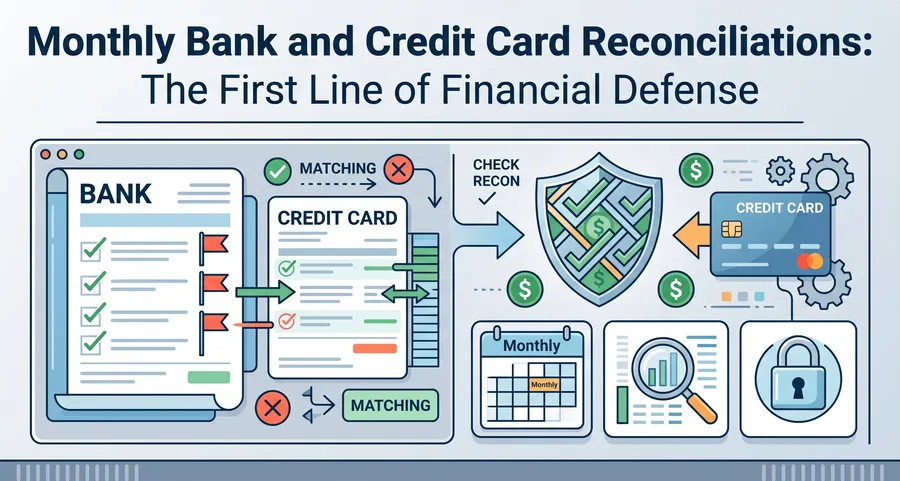
Many business owners assume that automated bank feeds in software like QuickBooks guarantee accurate books. In reality, these feeds often mask duplicated income, missing processing fees, and phantom balances. This article breaks down the step-by-step mechanics of formal month-end reconciliations, demonstrating why matching your ledger to official bank statements is your primary defense against fraud, tax miscalculations, and distorted cash flow. (396 characters)
In the modern landscape of cloud accounting, platforms like QuickBooks Online, Xero, and NetSuite have transformed how small and mid-sized businesses manage their financial records. Real-time bank feeds automatically stream transactions directly into your accounting software, making it feel as though your financial statements update themselves effortlessly. With bright green "Match" buttons and automated banking rules, it is easy to fall into a dangerous assumption: if the feed is up to date, the books must be accurate.
Unfortunately, this assumption leaves countless business owners vulnerable to distorted financial reporting, unnoticed fraud, and costly tax errors.
An automated bank feed is a convenient data conduit, but it is not a financial control. True accounting integrity requires a formal, month-end bank and credit card reconciliation. Matching your internal ledger against independent, third-party bank statements remains the single most critical control in accounting—the first line of financial defense for any growing business.
The Mirage of the Automated Bank Feed
To understand why monthly reconciliations are indispensable, one must first recognize the flaws inherent in automated bank feeds. Bank feeds rely on API connections between financial institutions and accounting software. These connections frequently experience technical glitches, server timeouts, password re-authentications, and sync disruptions.
When a bank feed glitches, three common issues emerge within the accounting records:
1. Duplicated Transactions
A temporary disconnect can cause the accounting software to pull the same batch of transactions twice upon re-establishing the link. If an owner or bookkeeper accepts these without verification, revenue or expenses become artificially inflated.
2. Dropped Transactions
Conversely, feeds can skip days or specific transactions during software updates, leaving gaps in your ledger that skew your profit and loss statement and hide legitimate expenses.
3. Misapplied Categorization Rules
Automated software rules often misinterpret transactions, categorizing internal bank transfers as operational expenses or mistaking incoming loan proceeds for tax-free sales revenue.
Relying solely on software feeds creates "phantom balances"—cash figures on your balance sheet that do not reflect what actually resides in your checking account. A formal bank reconciliation systematically strips away these technical errors, establishing a single source of financial truth.
Three Financial Blind Spots Uncovered by Formal Reconciliations
Beyond fixing technical software glitches, performing a monthly reconciliation uncovers critical operational issues that otherwise slip through the cracks.
1. Unauthorized Charges, Vendor Overbills, and Fraud
Businesses lose thousands of dollars each year to unchecked recurring subscription renewals, duplicate vendor invoices, and unauthorized employee spending. Banking regulations strictly limit the window of time in which a business can dispute unauthorized electronic transfers or fraudulent debit charges—often to just 30 to 60 days from the statement issue date.
A disciplined month-end reconciliation forces a line-by-line review of every outgoing dollar against official bank and credit card statements. This ensures that fraudulent ACH withdrawals, altered checks, or accidental recurring software subscriptions are identified and disputed within the bank’s strict liability window.
2. The Merchant Gateway Trap: Gross Revenue vs. Net Payouts
If your business accepts payments through platforms like Stripe, Square, PayPal, or Shopify, your bank feed only records the net payout deposited into your checking account.
Example Discrepancy Scenario
If a client pays $1,000 for a service and the payment processor retains a $30 transaction fee, the merchant deposits $970 into your bank account.
If your accounting system simply records the incoming deposit as revenue, your books will reflect:
- Understated Gross Revenue: Showing $970 instead of $1,000.
- Unrecorded Operating Expenses: Complete omission of the $30 merchant processing fee.
Over a full fiscal year, this compounding mismatch distorts your gross profit margins and misrepresents your true top-line revenue to tax authorities and prospective investors. A formal reconciliation process decouples net bank deposits, booking gross revenue while accurately capturing processor fees as distinct line-item expenses.
3. Uncleared Checks, Outstanding Deposits, and Timing Discrepancies
Both cash and accrual accounting must reckon with timing differences. When you write a physical check to a vendor, your internal ledger immediately records the outflow. However, that money may not leave your bank account for days, weeks, or even months.
Unreconciled ledgers often leave stale, uncleared checks sitting indefinitely on the balance sheet. This creates a false sense of available liquidity or, conversely, leads staff to double-enter payment records when vendors complain about missing checks. Monthly reconciliations isolate outstanding checks and deposits in transit, giving management an exact view of available cash versus committed funds.
The Mechanics: A 5-Step Month-End Reconciliation Process
A rigorous reconciliation is a structured accounting workflow. Here is how a professional accounting team executes a formal month-end reconciliation:
Step 1: Secure Statement Cutoffs and Ending Balances
The process begins with official bank and credit card statements—not digital dashboard snapshots. The statement ending date serves as the hard cutoff for the period.
Step 2: Validate Beginning Balances
Before matching current monthly activity, the reconciler must verify that the opening bank balance in the software perfectly matches the ending balance of the previous month’s reconciled statement.
Step 3: Match Activity Line-by-Line
Every deposit, withdrawal, interest credit, fee, and credit card swipe on the official bank statement is cross-referenced with the internal ledger. Transactions missing from software are posted.
Step 4: Investigate Discrepancy Deltas ($0.00 Target)
The goal of every bank reconciliation is a $0.00 difference between calculated ledger balance and bank statement ending balance. Unadjusted variances are investigated until fully accounted for.
Step 5: Lock the Reconciled Period and Archive Reports
Once balanced, the accounting system’s closing date is locked to prevent accidental edits or deletions. A formal Bank Reconciliation Report is archived alongside the source statement.
The Strategic Value: True Cash Flow Visibility and Audit Readiness
For business owners, monthly reconciliations provide benefits far beyond clean ledger lines:
- Accurate Decision-Making: Reliable numbers allow leaders to calculate true operational runway, project tax obligations accurately, and make confident capital investment decisions.
- Lender and Investor Confidence: Banks, underwriters, and equity partners require pristine financial statements. Unreconciled accounts signal weak internal controls and jeopardize loan approvals or company valuations.
- Stress-Free Tax Preparation: At year-end, reconciled books eliminate the need for expensive, time-consuming forensic cleanup work by your CPA, significantly reducing tax preparation costs.
Protecting Your Bottom Line
Automated accounting software is a powerful productivity tool, but automation without oversight is a financial risk. Monthly bank and credit card reconciliations transform raw transaction feeds into verified, decision-grade financial data.
By catching duplicate fees, detecting unauthorized charges early, and properly separating merchant processing fees, a structured month-end reconciliation process protects your bottom line and ensures you always know where your business stands.
Disclaimer: This article is for general informational purposes only. Tax laws change frequently and every situation is different — contact Belmoore Financial Solutions for guidance specific to you.
Related Services at Belmoore Financial
Learn how Belmoore Financial Solutions handles individual and business tax returns in Lancaster, PA.
Every return we file includes complimentary $1 Million Tax Audit Defense.
Lisa Belmonte, AFSP
Lisa is the founder and lead tax preparer at Belmoore Financial Solutions. With over a decade of experience, she helps individuals and small businesses in Lancaster, PA navigate complex tax situations with confidence.