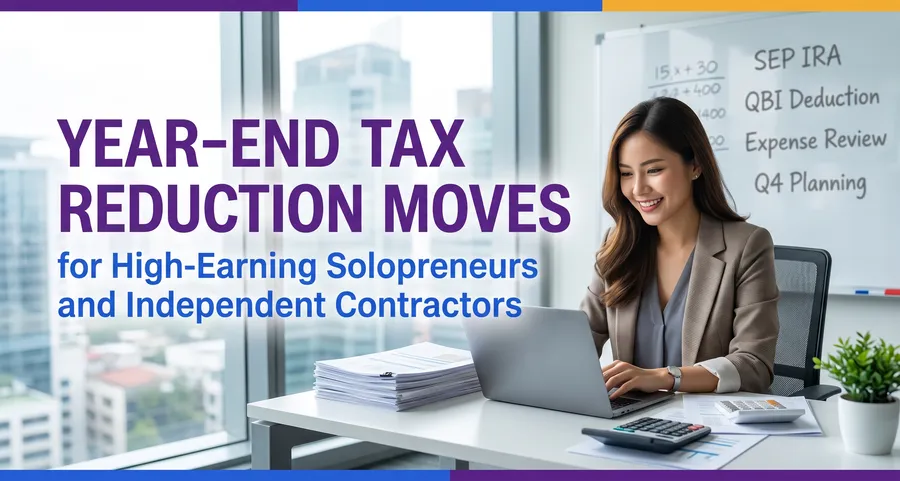
High net earnings often expose independent contractors to an aggressive combination of income and self-employment taxes. Waiting until April eliminates your most powerful mitigation options. This guide outlines actionable, audit-defensible year-end moves—from Solo 401(k) and SEP-IRA optimizations to formal accountable plans and Health Savings Accounts—designed to shelter your revenue, reduce your adjusted gross income, and keep your business fully compliant.
Article Excerpt & Synopsis
High net earnings often expose independent contractors to an aggressive combination of income and self-employment taxes. Waiting until April eliminates your most powerful mitigation options. This guide outlines actionable, audit-defensible year-end moves—from Solo 401(k) and SEP-IRA optimizations to formal accountable plans and Health Savings Accounts—designed to shelter your revenue, reduce your adjusted gross income, and keep your business fully compliant.
High-earning solopreneurs routinely overpay their taxes simply by running out the clock. When you operate as an independent contractor or single-member entity, every dollar of net profit is hit twice: first by standard federal and state income taxes, and second by the 15.3% self-employment tax.
Waiting until tax filing season in April limits your options to reactive reporting. To capture substantial tax savings and maintain ironclad audit defenses, you must execute your strategy before the fourth quarter closes.
The Mechanics of the Self-Employment Tax Trap
Traditional W-2 employees split their Federal Insurance Contributions Act (FICA) taxes with their employers. Independent operators pay the entire 15.3% tab alone—consisting of 12.4% for Social Security up to the annual wage cap and 2.9% for Medicare on all net earnings, plus an additional 0.9% Medicare surtax once income crosses threshold limits.
When your business produces $180,000 to $300,000 or more in profit, this tax burden compounds rapidly. Lowering this exposure legally requires reducing your Adjusted Gross Income (AGI)—which is your total gross income minus specific above-the-line statutory deductions—and isolating deductible business expenses through formal documentation.
Maximizing Above-the-Line Retirement Vehicles
Contributing to tax-advantaged retirement plans is the fastest way to shield revenue from current-year taxation while building long-term personal wealth. For solopreneurs with no full-time non-owner employees, two primary vehicles offer high contribution ceilings: the Solo 401(k) and the Simplified Employee Pension (SEP-IRA).
A Solo 401(k) allows you to contribute in two distinct capacities: as an employee through elective salary deferrals, and as an employer through profit-sharing contributions. Because the employee portion is a flat dollar allowance rather than a strict percentage of compensation, it offers massive sheltering capacity at lower gross revenues.
A SEP-IRA allows employer-only contributions calculated as a percentage of your net adjusted self-employment earnings (typically up to 20% for unincorporated sole proprietors, or 25% of W-2 wages for S-Corporations). While simpler to administer, it requires significantly higher top-line profits to hit maximum limits.
Solo 401(k) Tax Arbitrage in Action
Consider Marcus, an independent systems consultant operating as a sole proprietor. In 2026, Marcus generates $220,000 in net Schedule C profit. Without proactive planning, his entire profit flows directly onto his tax return, landing his top dollars in a 32% federal bracket alongside self-employment taxes.
Marcus establishes and funds a Solo 401(k) before December 31. He contributes the maximum employee elective deferral of $23,500. He also calculates an employer profit-sharing contribution of approximately $39,000 based on his adjusted net earnings.
Result: His total contribution equals $62,500. By shifting this capital directly into his pre-tax plan, Marcus reduces his taxable business income from $220,000 to $157,500. At a combined 32% federal and 5% state tax rate, this single transaction creates an immediate $23,125 reduction in his current-year tax liability while keeping the full $62,500 growing tax-deferred in his portfolio.
Triple-Tax-Advantaged Sheltering with HSAs
If your health insurance coverage is tied to a qualified High Deductible Health Plan (HDHP), opening and funding a Health Savings Account (HSA) delivers the most tax-efficient structure in the Internal Revenue Code.
HSAs offer a triple-tax advantage. Your contributions are 100% tax-deductible against your income. The funds inside the account grow completely tax-free through investments. Withdrawals used for qualified medical expenses are never taxed.
Unlike Flexible Spending Accounts (FSAs), HSA balances never expire at year-end. You can pay routine out-of-pocket medical costs with personal cash today, preserve the receipts digitally, allow your invested HSA balance to compound for decades, and reimburse yourself tax-free at any point in the future.
Formalizing Business Deductions via Accountable Plans
The Internal Revenue Service looks closely at solopreneurs who write off large vehicle and travel expenses directly against revenue without structural support. If your business operates as an S-Corporation or LLC taxed as a corporation, claiming business mileage or travel on personal credit cards without a formal system can trigger expense disallowances during an examination.
The legal solution is establishing a written Accountable Plan. An Accountable Plan is an administrative policy adopted by your business that reimburses you as an individual for business expenses paid out of personal funds.
To satisfy IRS compliance rules, an Accountable Plan must meet three specific criteria:
- Every expense must possess a direct, documented business connection.
- Expenses must be substantiated with dates, locations, amounts, and explicit business purposes within a reasonable timeframe.
- Any excess reimbursement paid to the individual must be returned to the business within a designated period.
Reimbursements paid through a valid Accountable Plan are fully deductible by the business entity and completely tax-free to the business owner. They do not appear on your W-2 as taxable wages, protecting the payout from both income and employment taxes.
Accountable Plan Travel and Mileage Recovery
Consider Elena, an independent enterprise software developer structured as a single-member S-Corporation. Over the year, Elena uses her personal vehicle for client on-site visits, totaling 12,000 qualified business miles. She also uses her personal credit card for $6,500 in client dinners, lodging, and technical conference registrations.
Without an Accountable Plan, taking $15,000 out of her corporate account to cover these personal card charges could be reclassified by an auditor as taxable owner distributions or unrecorded wages subject to payroll penalties.
Elena implements a formal Accountable Plan before year-end. She submits monthly expense logs alongside itemized receipts and a mileage tracking log generated by GPS software.
Result: Her corporation writes her a formal reimbursement check for $14,900 ($8,400 standard mileage reimbursement plus $6,500 travel/meals). Her S-Corporation records a clean $14,900 operating expense deduction. Elena receives the $14,900 into her personal bank account completely tax-free, with full contemporaneous proof neutralizing audit vulnerability.
Accelerating Expenses and Deferring Income
Cash-basis solopreneurs have significant control over the timing of their taxable profits during the final sixty days of the tax year.
If you anticipate landing in a high tax bracket this year, you can accelerate ordinary, necessary business expenses into the current calendar year. Pre-paying annual software subscriptions, purchasing essential computer hardware, renewing professional liability policies, or booking required continuing education before December 31 pulls those deductions into the present tax cycle.
For tangible equipment purchases, review Section 179 expensing and bonus depreciation rules with your tax professional. These provisions permit businesses to deduct the full purchase price of qualifying hardware, servers, and office equipment in the year placed into service, rather than depreciating the cost slowly over multiple tax years.
Conversely, if cash flow permits, consider deferring mid-December customer invoices until the first week of January. Delaying the receipt of customer payments pushes that gross revenue into the following tax year, providing you with a full twelve-month runway before tax becomes due on those funds.
Implementing Audit Protection Best Practices
A tax mitigation strategy is only as strong as your documentation. Aggressive deductions without contemporaneous records invite costly penalties during an audit.
Protect your business by maintaining strict operational boundaries:
- Never mingle personal and business funds: Maintain separate merchant processing and operating bank accounts dedicated solely to entity activities.
- Maintain digital audit trails: Save digital copies of all invoices, mileage logs, and receipts categorized by vendor and specific business objective.
- Formalize corporate decisions: Keep detailed minutes of your annual corporate meetings and formal board resolutions approving retirement contributions and plan implementations.
Year-end tax planning is an active operational discipline. By deploying formal retirement accounts, funding health savings vehicles, and structuring your corporate expense reimbursements before December 31, you legally minimize your self-employment tax burden while building an audit-proof business foundation.
Disclaimer: This article is for general informational purposes only. Tax laws change frequently and every situation is different — contact Belmoore Financial Solutions for guidance specific to you.
Related Services at Belmoore Financial
Learn how Belmoore Financial Solutions handles individual and business tax returns in Lancaster, PA.
Every return we file includes complimentary $1 Million Tax Audit Defense.
Lisa Belmonte, AFSP
Lisa is the founder and lead tax preparer at Belmoore Financial Solutions. With over a decade of experience, she helps individuals and small businesses in Lancaster, PA navigate complex tax situations with confidence.