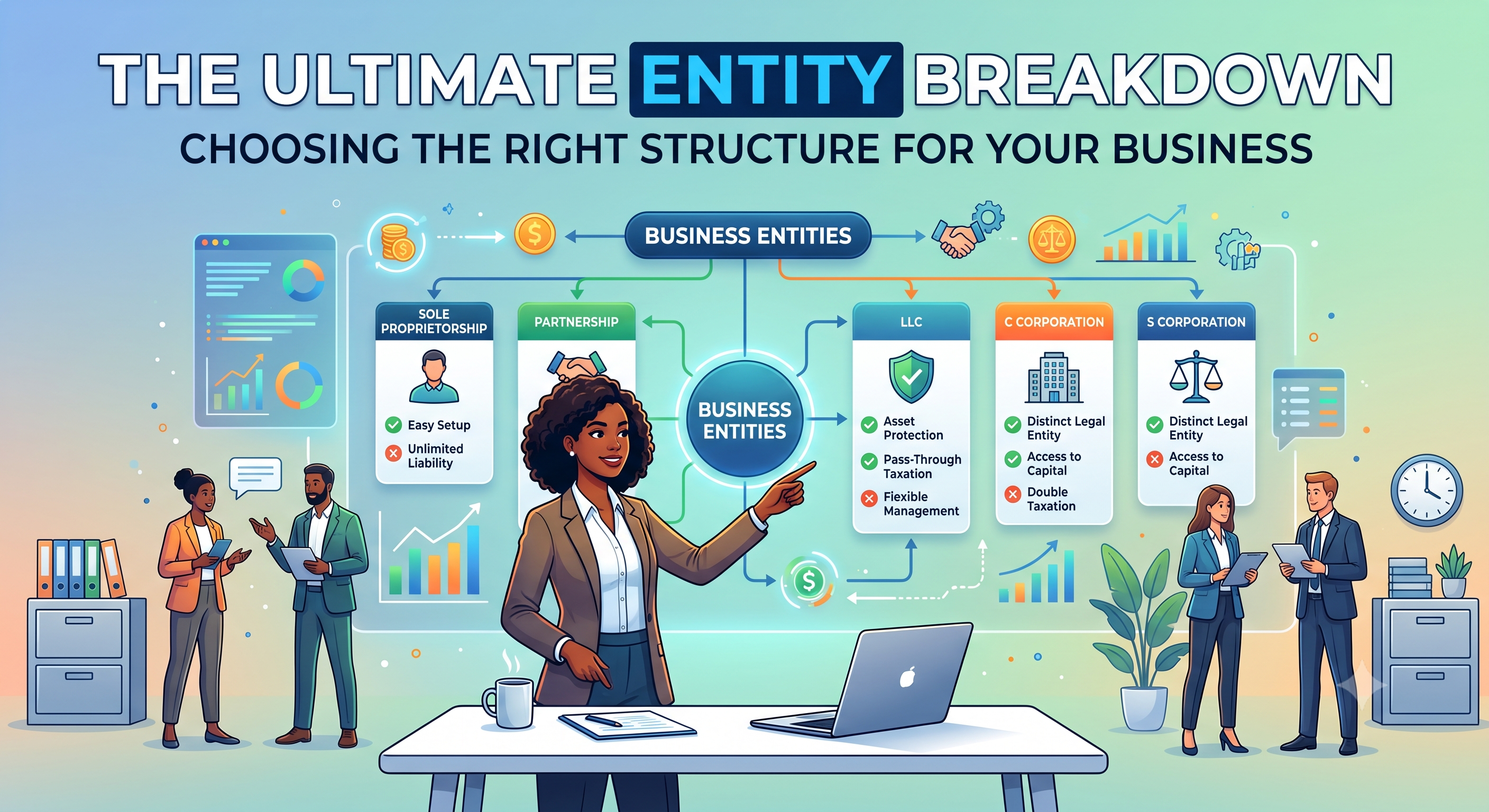
Before you print business cards or launch your website, you need to make one crucial decision: your business structure. The entity type you choose impacts everything — from daily operations and personal liability to your tax bill and administrative duties. Terms like pass-through taxation and corporate veils can feel overwhelming, but understanding business entities doesn't require a law degree. Here's a breakdown of the core structures to help you find the right fit.
1. Sole Proprietorship: The Simple Default
A Sole Proprietorship is the simplest and most common legal structure. If you start conducting business as an individual without registering as any other business entity, you automatically operate as a sole proprietor. There is no distinction between you and your business.
Pros: Minimal paperwork, low startup costs, and complete operational control. Taxes are straightforward—business income and expenses are reported directly on your personal tax return (Schedule C).
Cons: Unlimited personal liability. Because there is no legal separation between you and the business, your personal assets (home, savings, vehicle) are at risk if the business incurs debt or faces a lawsuit.
2. General Partnership: The Shared Venture
A Partnership is similar to a sole proprietorship, but designed for two or more co-founders. Partners agree to share in profits, losses, and management responsibilities, usually outlined in a written Partnership Agreement.
Pros: Easy to form, pooled resources and expertise, and flexible management structures. Income passes through to partners' individual tax returns.
Cons: Joint and several liability. Each partner is personally liable not only for business debts but also for the actions and financial obligations incurred by the other partners on behalf of the business.
3. Limited Liability Company (LLC): The Shield
The Limited Liability Company (LLC) is often the sweet spot for modern small businesses. It bridges the gap between simple sole proprietorships and formal corporations by offering liability protection without corporate complexity.
Pros: Limited personal liability protects your personal assets from business debts and claims. It offers pass-through taxation by default, flexible management structures, and enhanced credibility with clients and vendors.
Cons: Requires state filing fees and ongoing annual compliance depending on your state. Owners operating as a default LLC must pay self-employment taxes on all net business profits.
4. S Corporation (S-Corp Tax Election): The Tax Saver
An S Corporation is not a distinct legal entity type that you incorporate on its own; rather, it is a federal tax status elected with the IRS by filing Form 2553. A business can be structured as a standalone legal entity—either formed initially as a state-level corporation or as an LLC—and elect S-Corp status at formation or at any point in its business lifecycle.
Pros: Potential savings on self-employment taxes. Owners who actively work in the business pay themselves a reasonable salary through payroll (subject to payroll taxes) and can draw remaining net profits as distributions, which are exempt from self-employment taxes.
Cons: Strict eligibility requirements (e.g., maximum 100 shareholders, U.S. citizens/residents only, single class of stock) and increased administrative overhead, including mandatory formal payroll management and dedicated corporate tax return filings (Form 1120-S).
Side-by-Side Comparison Guide
| Structure | Liability Protection | Taxation Model | Best Suited For |
|---|---|---|---|
| Sole Prop | None (Personal risk) | Pass-through (Personal) | Low-risk solo ventures, freelancers |
| Partnership | None (Joint risk) | Pass-through (Personal) | Two or more co-founders testing ideas |
| LLC | Strong (Assets protected) | Pass-through default | Most small business owners & service providers |
| S-Corp Status | Strong (Assets protected) | Pass-through + Tax optimization | Businesses seeking to reduce self-employment taxes at formation or as profits grow |
Key Takeaway: Most small business owners choose an LLC for straightforward asset protection and flexible operations. If reducing self-employment tax burden is a priority and you are prepared to manage formal payroll, electing S-Corp tax status—either at formation or as revenues grow—offers substantial financial advantages.
Lisa Belmonte, AFSP
Lisa is the founder and lead tax preparer at Belmoore Financial Solutions. With over a decade of experience, she helps individuals and small businesses in Lancaster, PA navigate complex tax situations with confidence.