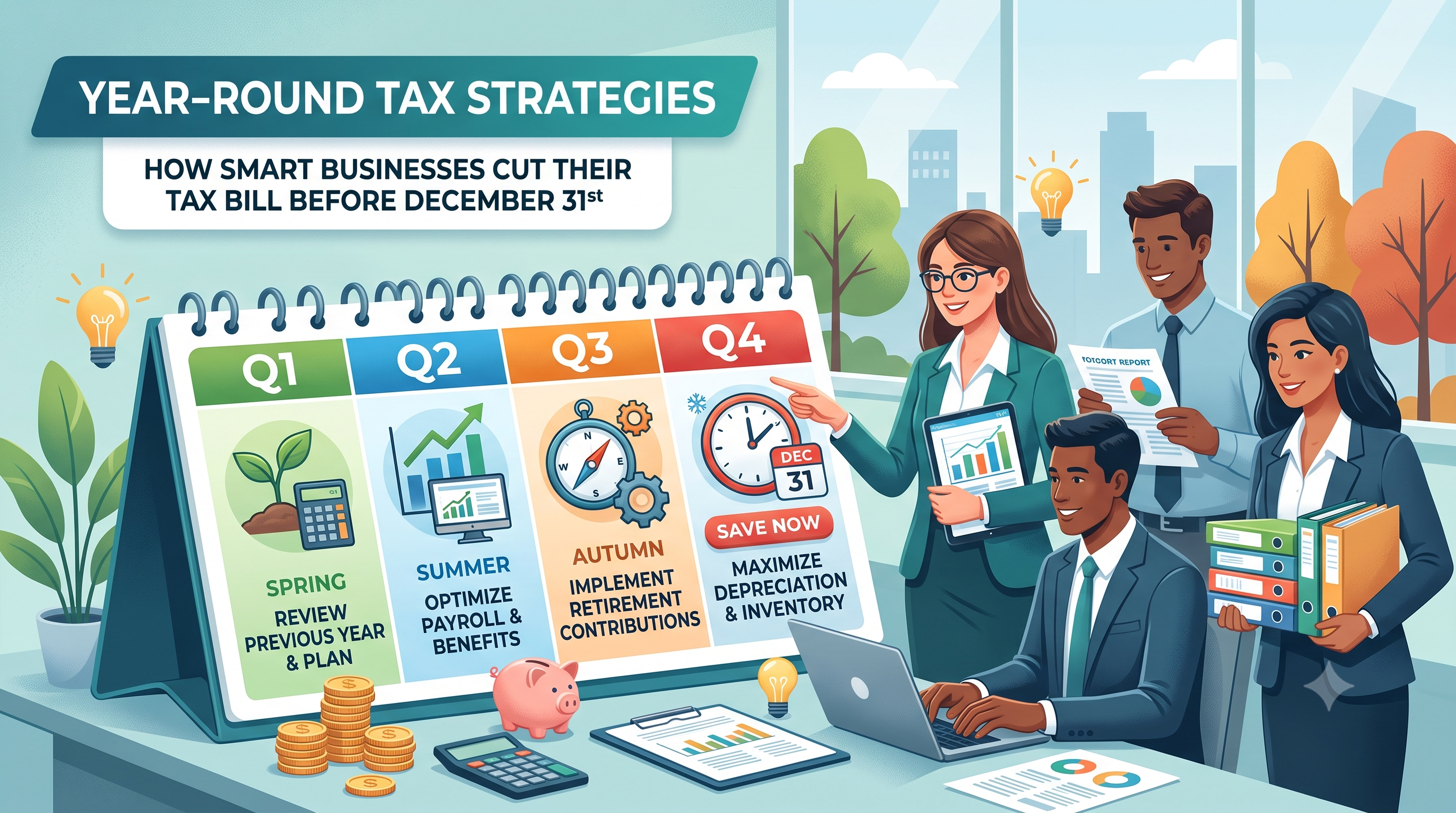
Most business owners wait until April to think about taxes, but the real money is saved before December 31st. Waiting until spring means you are only reporting past choices rather than changing your financial outcome. By shifting from reactive tax preparation to proactive tax planning, you can legally keep more of your profits. This guide walks you through key year-end strategies—like Section 179 equipment write-offs and retirement contributions—that cut your tax bill before the year ends.
Tax Prep Looks Backward. Tax Planning Looks Forward.
Tax preparation happens in April. It is the process of filing forms based on what already happened. By then, your tax bill is set in stone.
Tax planning happens all year long. It is the process of making strategic business decisions before December 31st to actively lower what you owe.
If you wait until spring to think about taxes, you leave money on the table. Here is how smart business owners take control of their tax bill before the calendar turns.
Deduct Full Equipment Costs with Section 179
Buying equipment for your business usually means spreading the tax deduction over several years. This process is called depreciation.
Section 179 changes that rule. It is a tax provision that lets businesses deduct the full purchase price of eligible equipment or software in the same year they buy it.
Concrete Example:
Imagine Sarah runs a graphic design agency. In November, she purchases $12,000 worth of new high-performance computers and office furniture. Instead of deducting a small fraction of that cost each year for five years, she uses Section 179. She deducts the entire $12,000 from her taxable income for the current year. If her tax rate is 25%, that single purchase saves her $3,000 on her tax bill.
To qualify, the equipment must be purchased, delivered, and put into service by December 31st.
Lower Taxes While Building Your Retirement
Putting money into a business retirement account does double duty. It builds your personal wealth while shrinking your current taxable income.
Options like a SEP IRA (Simplified Employee Pension) or a Solo 401(k) allow self-employed individuals and small business owners to save far more than traditional IRAs.
Concrete Example:
Consider Marcus, an independent consultant making $110,000 in net profit. If he does nothing, he pays income tax on the full $110,000. Instead, Marcus sets up a SEP IRA before the deadline and contributes $20,000. That contribution directly reduces his taxable income to $90,000. He keeps $20,000 working for his personal future while immediately cutting thousands off his current tax obligation.
Prepay Expenses to Reduce Current Income
If your business uses cash-basis accounting—meaning you record income when received and expenses when paid—you can time your payments to lower your profit line.
Look ahead at expenses you know you will face early next year. Paying them before December 31st pulls those write-offs into the current tax year.
Common expenses you can prepay include:
- Property or office rent for January.
- Annual business insurance premiums.
- Software subscriptions and web hosting fees.
- Professional membership dues and vendor retainers.
Every eligible dollar spent in December is a dollar removed from this year's taxable income.
Review Your Financials Before the Clock Runs Out
Proactive tax planning requires clear financial data. Do not wait for your accountant to call you in March.
Schedule a quick year-end review in November or early December. Look at your year-to-date profit and estimate your remaining revenue.
When you know where your business stands before December 31st, you still have time to purchase needed tools, fund your retirement, or prepay upcoming costs. Once January 1st arrives, those opportunities disappear.
Lisa Belmonte, AFSP
Lisa is the founder and lead tax preparer at Belmoore Financial Solutions. With over a decade of experience, she helps individuals and small businesses in Lancaster, PA navigate complex tax situations with confidence.