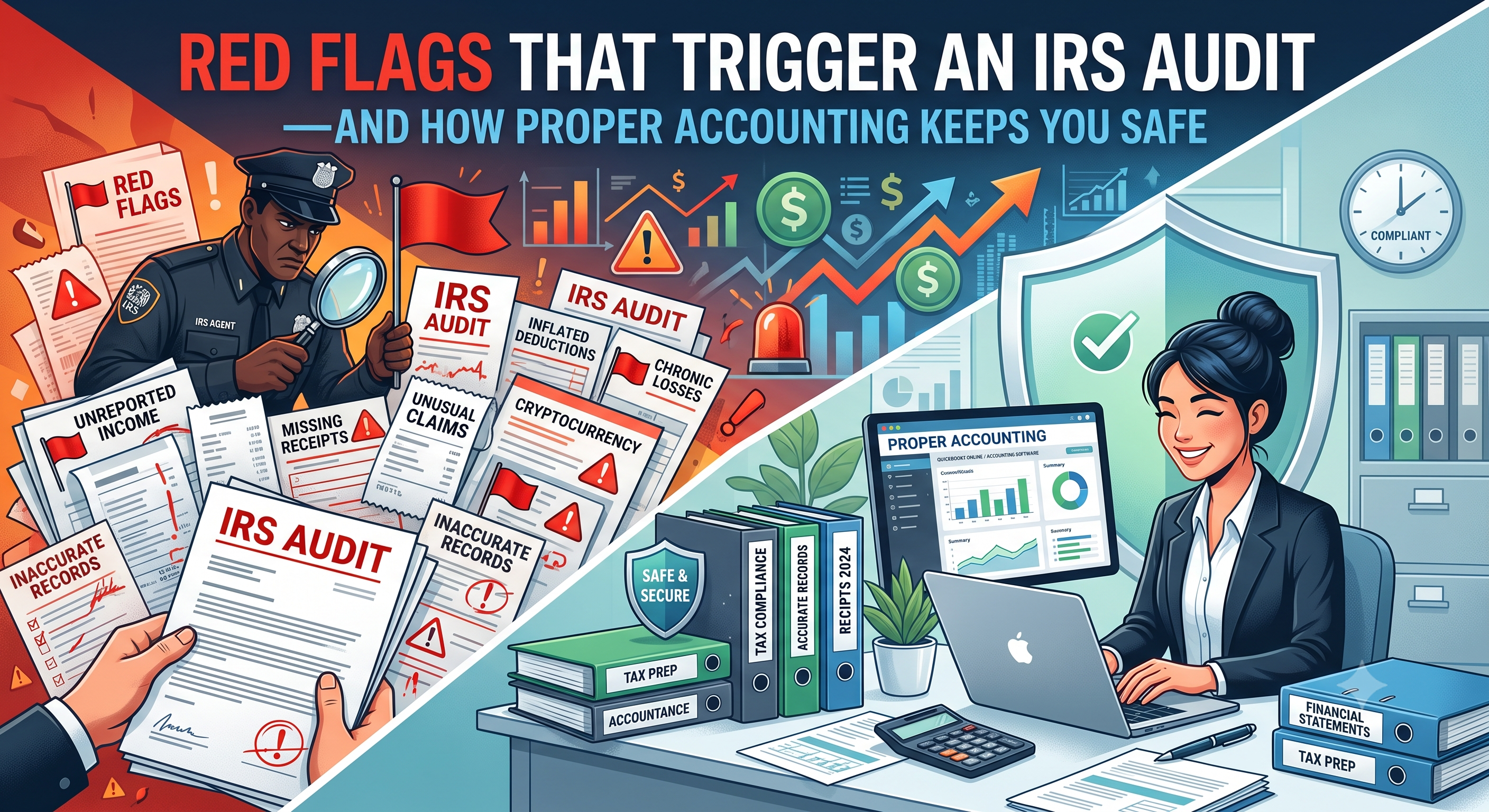
An IRS audit can cost small business owners thousands of dollars and endless stress. Fortunately, most audits aren't random. They are triggered by simple, preventable red flags like mismatched numbers, rounded expenses, or misclassified workers. In this guide, you will learn the most common tax triggers and how professional, accurate accounting practices safeguard your hard-earned money and give you complete peace of mind.
An IRS audit is every small business owner’s nightmare, but most audits happen because of preventable errors in your bookkeeping.
The IRS relies on automated computer systems to analyze tax returns. When your numbers look unusual compared to similar businesses, the system flags your return for manual review.
Knowing what triggers an audit—and maintaining clean books—is the best way to protect yourself.
The Most Common IRS Audit Triggers
1. Excessive or Rounded Expenses
Estimating your tax deductions is a quick way to invite an audit. The IRS expects exact numbers. If your tax return is full of perfect, round numbers, tax examiners assume you are guessing rather than keeping receipts.
Imagine claiming exactly $5,000 for office supplies and $10,000 for travel on your tax return. Real-world business expenses almost always end in odd dollars and cents, like $4,821.43. Clean, round numbers raise an immediate flag in the IRS computer system.
2. Mismatched Income Documents
The IRS receives copies of every official tax form sent to you by clients, banks, and payment processors. Their automated system cross-checks these forms against the income you report on your return.
If a client files a Form 1099-NEC (an official tax form used to report payments made to independent contractors) showing they paid you $15,000, but your tax return only lists $12,000 in income, the system detects a mismatch instantly. You will automatically receive a notice demanding an explanation and additional taxes.
3. Reporting Continuous Business Losses
It is normal for a new business to lose money in its first year or two. However, if you report business losses for three out of five years, the IRS may reclassify your business as a hobby.
Tax law does not allow you to deduct losses from a hobby against your regular income. If the IRS decides your business is a hobby, they will disallow past deductions and charge back taxes plus severe financial penalties.
4. Misclassifying Employees as Contractors
Hiring independent contractors saves money on payroll taxes and benefits. Because of this, the IRS heavily inspects businesses that pay workers via 1099 forms instead of issuing W-2 forms.
If you dictate a worker's hours, provide their equipment, and control how they do their job, the IRS considers them an employee. Misclassifying them can result in massive financial penalties and unpaid tax claims.
How Proper Accounting Keeps You Safe
Avoiding an audit does not mean missing out on legitimate tax deductions. It simply means backing up every claim with organized financial data. Proper accounting acts as a shield for your business in three major ways:
Peace of Mind for Your Business
If the IRS ever questions your return, having clean, professional financial records makes answering them simple. Instead of panicking and digging through shoeboxes of faded receipts, you can provide clear digital reports instantly.
Don't wait for a letter from the IRS to organize your finances. Investing in professional accounting today protects your business, saves you money on taxes, and gives you complete peace of mind.
Lisa Belmonte, AFSP
Lisa is the founder and lead tax preparer at Belmoore Financial Solutions. With over a decade of experience, she helps individuals and small businesses in Lancaster, PA navigate complex tax situations with confidence.